
Fred Fischer, Senior Vice President

London Calling
On June 9-10, 2025, principal negotiators for the United States and China met in London for nearly 20 hours of negotiations over two days to hammer out a framework agreement to implement their previous agreement negotiated in Geneva on May 10-11, 2025. The London negotiations were led on the U.S. side by Treasury Secretary Bessent, Commerce Secretary Lutnick, and USTR Greer, and led on the China side by Vice Premier He Lifeng, Commerce Minister Wang Wentao, and Vice Minister of Commerce Li Chenggang.
The London meeting followed a call between President Xi and President Trump on June 5th (the first such call by the two leaders since President Trump’s inauguration in January 2025). According to a readout of the call, the two presidents focused primarily on trade issues, with both leaders expressing a desire to resolve ongoing tensions and improve economic relations. The fact that both sides agreed to high-level negotiations within days of the presidential call reflects the importance that both leaders are placing on preventing economic relations from drifting farther apart.
The Geneva Agreement
The Geneva Agreement primarily focused on reducing the very high tariffs that both sides had imposed on each other following the U.S. reciprocal tariff announcement on April 2nd. The lower tariffs are to remain in place for 90 days. The agreement also committed China to removing non-tariff countermeasures taken against the United States since April 2, 2025, which included restrictions on export licenses for critical minerals and magnets. The affected critical minerals are Scandium (Sc), Yttrium (Y), Samarium (Sm), Gadolinium (Gd), Terbium (Tb), Dysprosium (Dy), and Lutetium (Lu). These elements are critical for various industry sectors, including defense, energy, and automotive among others.
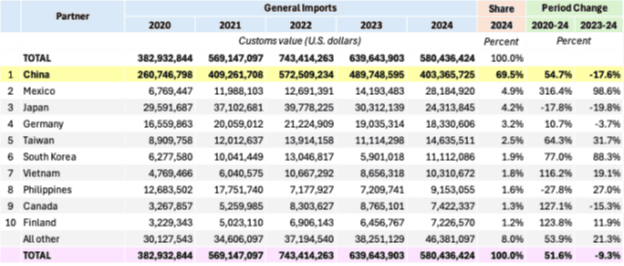
Table 1 presents U.S. imports of the seven affected critical minerals from 2020 to 2024. The United States imported $164.0 million in 2024, including $117.2 million from China, which accounted for 71.4% of U.S. imports. Table 2 presents U.S. imports of permanent magnets from 2020 to 2024. The United States imported $580.4 million in 2024, including $403.4 million from China, which accounted for 69.5% of U.S. imports.
Table 1
U.S. imports of affected critical minerals 1, by partners, 2020-2024
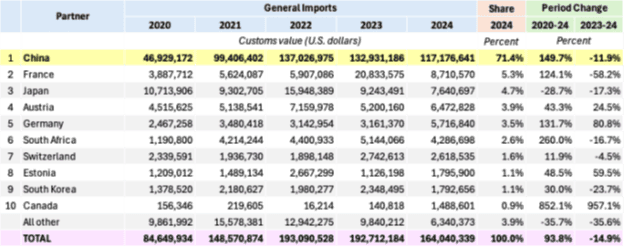
Table 2
U.S. imports of permanent magnets,1 by partners, 2020-2024
Within days of the Geneva agreement, both sides began accusing each other of reneging on the text and spirit of the Geneva agreement. The United States accused China of blocking export licenses for certain rare earth minerals and permanent magnets, while China accused the United States of imposing new export controls on a range of goods including semiconductor design software, jet engines and related parts, and ethane, and threatening to cancel visas for Chinese students.
The London Agreement
From the outset, the purpose of the London meeting was for both sides to successfully implement the terms of the Geneva agreement. However, unlike the Geneva agreement, the London agreement did not include a joint statement or publication of agreement text, White House press release, or fact sheet. Therefore, what we know about the agreement has been gleaned from statements to the press.
Secretary Lutnick stated that the agreement would remove restrictions on Chinese exports of rare earths minerals and magnets and some of the recent U.S. export restrictions “in a balanced way,” but did not provide further details. He also said that both sides will present the framework agreement to their respective presidents for approval. China’s Vice Commerce Minister, Li Chenggang, confirmed that a trade framework had been reached in principle that would be taken back to U.S. and Chinese leaders. President Trump said, “Our deal with China is done, subject to final approval with [P]resident Xi and me…”
The agreed framework likely establishes a technical-level working group to address implementation issues as they arise to limit the need for principal-level interventions. We have heard from industry that China is now approving export licenses for critical minerals.
Challenges Remain
The fact that high-level principals were engaged in two long days of negotiations on a narrow set of issues indicates that these were difficult discussions. Both sides are seeking concessions on diametrically opposed positions in strategically sensitive priorities. This same challenge applies to most other outstanding trade issues between the United States and China. The extension of invitations for mutual official visits by both Presidents should create momentum for further negotiations with possible positive outcomes.
China’s Trade Negotiation Priorities
- Removing U.S. technology export controls
- Reducing in-bound and out-bound investment restrictions
- Eliminating U.S. import tariffs (fentanyl, reciprocal, Section 232 sectoral, and Section 301)
- Minimizing the effectiveness of U.S. economic containment policies
- Maintaining long-term stable economic relations
- Broadening economic and political cooperation where interests align
U.S. Trade Negotiation Priorities
- Maintaining access to China’s critical minerals
- Reducing China’s direct and third-country exports to the United States
- Increasing market access in China for U.S. exports and U.S. companies
- Reversing China’s unfair trade practices
- Lowering state subsidies in strategic sectors
- Addressing China’s currency manipulation
- Improving China’s labor and environmental practices
AGS will continue to monitor ongoing trade talks and implementation of the agreements and provide additional insights and analysis as needed.
To stay up to date on what AGS is doing, follow us on LinkedIn