
Anthony Ruggiero, Senior Vice President

On Friday, President Trump and Russian President Vladimir Putin are scheduled to meet in Alaska for a summit to discuss an end to the war in Ukraine. Although the meeting will be closely watched for significant developments, the Trump administration is notably downplaying its expectations for any major agreement or outcome.
Trump has tried to negotiate a ceasefire by leveraging U.S. economic and military influence, while Putin is seeking to solidify Russia’s territorial gains in eastern Ukraine and block Kyiv’s NATO aspirations. Ukrainian President Volodymyr Zelenskyy staunchly opposes territorial concessions, emphasizing Ukraine’s sovereignty, and European leaders insist on Kyiv’s inclusion in any negotiations. Senior Trump administration officials have suggested recently that a meeting between Trump, Putin, and Zelensky, could soon be in the works.
Both sides are consulting with respective partners before the Alaska summit. Trump spoke with European leaders and Zelenskyy on Wednesday and Putin spoke with North Korean leader Kim Jong Un. North Korea has supported Putin with artillery, missiles, soldiers, and overseas workers. Kim also has direct experience negotiating with Trump in his first term. Ultimately, Kim misjudged Trump, and the Hanoi summit ended in failure.
Earlier this week, Trump reiterated that territorial exchanges will likely have to take place to end the war, saying, “There will be land swapping to the good of Ukraine, also some bad stuff for [Ukraine and Russia].” However, Trump has sought to downplay expectations for Friday’s meeting with Putin, saying, “This is really a feel out meeting.” VP Vance suggested the U.S. could reduce its military and economic support for Ukraine, “We’re done with the funding of the Ukraine war business, we want to bring about a peaceful settlement to this thing.” It is unclear if Trump agrees with this approach, he recently agreed to send military support to European countries who export their own supplies of military hardware to Ukraine.
Last week, Putin presented a proposal to U.S. Special Envoy Steve Witkoff for a complete ceasefire if Ukraine withdraws all its forces from the eastern Donetsk region. Russia would then control the Donetsk and Luhansk regions, as well as the Crimea peninsula, which it seized in 2014 and wants recognized as sovereign Russian territory. Russia would then negotiate land swaps with Kyiv for the Zaporizhzhia and Kherson regions.
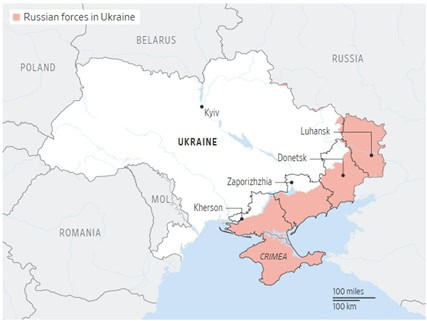
Recent battlefield developments in Ukraine shows a deteriorating situation for Kyiv, strengthening Russia’s leverage ahead of the summit and also playing into Putin’s approach to wait for additional gains on the ground. Russian forces have made a sudden advance in parts of eastern Ukraine, particularly in Donetsk, capturing key villages and pushing toward a critical defensive hub, according to reports. This follows advances in Luhansk, where Russian forces have made recent gains. Ukraine’s military is under strain, with recruitment challenges and limited Western aid exacerbating losses. Despite some small territorial gains, Kyiv struggles to counter Russia’s slow but steady progress.
Three potential scenarios could emerge from the summit:
- First, and most likely, no significant deal or ceasefire is reached. Zelenskyy’s rejection of territorial concessions and Putin’s insistence on retaining Donetsk, Luhansk, and Crimea, as well as significant concessions from Ukraine on the Zaporizhzhia and Kherson regions, make agreement unlikely. Ukraine’s exclusion from initial talks and Europe’s demand for reciprocal territorial withdrawals likewise complicate negotiations. Trump could respond with additional sanctions and tariffs targeting Russia’s energy exports, financial sector, and secondary sanctions. This week, Trump said, if Putin doesn’t agree to stop the war at the meeting, “there will be very severe consequences.”
- Second, a partial ceasefire, such as a 30-day pause on civilian infrastructure attacks, is possible but fragile. Building on prior Trump-Putin discussions, this could reduce direct hostilities but would not address core issues like territorial control or security guarantees. Similar past agreements collapsed when Russia resumed attacks, and Ukraine’s absence from the table could undermine this outcome. This could include a pledge to pause sanctions tied to Russia’s compliance with the ceasefire.
- Third, and least likely, a grand deal involving a ceasefire, land exchanges, and/or security guarantees that could stabilize the frontline. However, this would require Zelenskyy to compromise on territorial integrity and Putin to accept limits on Russia’s gains, both politically challenging. European support and NATO-backed guarantees could facilitate this, but Putin’s demand for Ukraine’s NATO exclusion or other security guarantees presents significant obstacles. This option could include an initial freezing or temporary lifting of a subset of sanctions tied to the ceasefire with an eventual removal of most sanctions in a final deal.
AGS will continue to monitor developments in the Alaska summit, Ukraine War and potential ceasefire discussions and provide relevant updates as needed.
To stay up to date on what AGS is doing, follow us on LinkedIn