
June 23, 2025
Fred Fischer, Senior Vice President

On June 16, 2025, President Trump and UK Prime Minister Keir Starmer signed a bilateral trade deal that was original agreed in principle on May 8, 2025. The signing took place at the G7 Summit in Kananaskis, Alberta, Canada.
Relevant documents:
- General Terms for the United States of America and the United Kingdom of Great Britain and Northern Ireland Economic Prosperity Deal, May 8, 2025, link is here.
- Fact Sheet: U.S.-UK Reach Historic Trade Deal, May 8, 2025, link is here.
- Executive Order: Implementing the General Terms of the United States of America-United Kingdom Economic Prosperity Deal, June 16, 2025, link is here.
- Fact Sheet: Implementing the General Terms of the U.S.-UK Economic Prosperity Deal, June 17, 2025, link is here.
Agreed Actions
The following provisions will be implemented by June 30, 2025, seven days following publication of the Executive Order in the Federal Register:
- Passenger Vehicles: The United States will provide an annual tariff-rate quota (TRQ) of 100,000 vehicles for imports of passenger vehicles from the United Kingdom (UK) at a 10 percent tariff rate (2.5% MFN + 7.5% tariff). The TRQ quota amount will be adjusted for this year to reflect a May 8, 2025, start date. Imports of automobiles exceeding the TRQ will be subject to existing Section 232 tariffs (currently 25%). The TRQ will be effective 7 days after publication in the Federal Register.
- Auto Parts: UK auto parts imported for use in UK vehicles (service parts) will be subject to a total tariff of 10 percent (2.5% MFN + 7.5% tariff) and will not be limited by a quota. This provision will be effective as of the date of publication in the Federal Register.
- Aerospace Products: The Executive Order restores tariff-free bilateral trade for products of the UK that are covered under the WTO Agreement on Trade in Civil Aircraft. Such aircraft and parts will be exempted from reciprocal tariffs and Section 232 steel and aluminum tariffs. The status of potential tariffs or other remedies that may be imposed in the pending Section 232 investigation on civil aircraft remains to be determined.
Future Actions
The following actions will be implemented at unspecified future dates:
- Steel and Aluminum TRQ: Commerce and USTR will design a TRQ at most-favored-nation (MFN) rates for steel and aluminum articles and certain derivative steel and aluminum products of the United Kingdom. Implementation of the TRQ requires the UK to meet certain requirements on the security of steel and aluminum supply chains and the ownership of production facilities.
- Pharmaceuticals: The United States will provide unspecified preferential treatment for UK pharmaceuticals and pharmaceutical ingredients, contingent on the findings of the Section 232 investigation, and the UK meeting certain supply chain security standards.
- Applied Tariffs: Both countries agreed to reduce applied tariffs on a preferential basis on a range of goods imported from each country.
- Agricultural Market Access: Both countries agreed to negotiate enhanced market access for agricultural goods and to cooperate on sanitary and phytosanitary (SPS) standards and other mutually agreed standards.
- Beef: The UK agreed to remove the in-quota 20% tariff on U.S. beef exports, while the United States agreed to provide preferential access to an existing TRQ on U.S. beef imports.
- Ethanol: The UK will offer a preferential duty-free TRQ of 1.4 billion liters for U.S. ethanol.
- Digital Trade: Both countries agreed to negotiate an ambitious set of digital trade provisions to include financial services.
- Mutual Recognition of Standards: Both countries agreed to build on existing Mutual Recognition Agreements (MRAs) that provide for mutual recognition of standards and conformity assessment procedures for certain goods and services, and to cooperate on international standards.
- Intellectual Property, Labor, and Environmental Provisions: Both countries confirmed they intend to discuss high-standard commitments related to intellectual property rights protection and enforcement, labor practices (including addressing forced labor in supply chains), and environmental policies and practices.
Next Steps
- Negotiations move to a more technical phase in which draft text will be negotiated to flesh out identified commitments in greater detail
- Tariff-rate quotas (TRQs) for steel and aluminum will need to be negotiated, and details on preferential treatment for other Section 232 sectors still need to be worked out
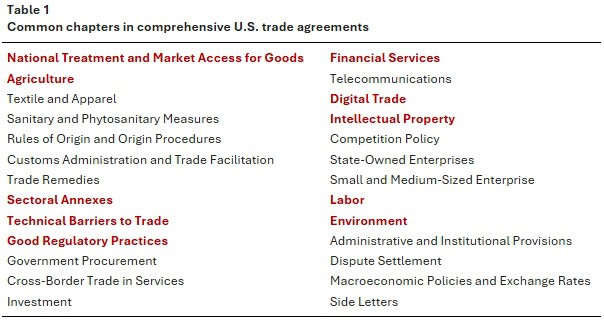
- Subjects listed below in Table 1 in RED are specifically referenced in the implementing agreement and represent subject areas for further negotiation
- For the EPD to become a comprehensive trade agreement, most or all the other subject areas would need to be addressed with text negotiated in a final agreement
- To become a legally binding agreement, Congress would eventually need to codify and ratify these commitments through implementing legislation
The AGS report, including data visualizations and supporting statistics, can be viewed at the link below:
To stay up to date on what AGS is doing, follow us on LinkedIn