Leadership insights on current global geopolitical, economic and security trends
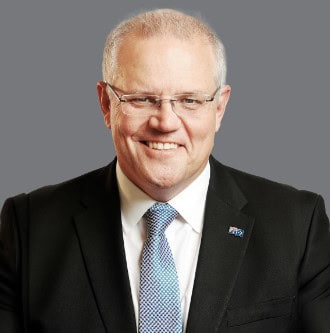
Hon. Scott Morrison, AGS Non-Executive Vice Chairman
Issue 1: July 2024
Welcome to this first edition of a View from Downunder, providing insights on current trends and events in geopolitics, the economy and security issues around the world from my perspective and experience as former Prime Minster of Australia from 2018-22.
Executive Summary
The world is not getting any simpler. The failed assassination attempt on President Trump demonstrates it is getting less predictable and more dangerous. Geo-politics, global security issues, and deepening political polarisation is now fused with the global economy in a way that is redefining the investment landscape, how the world is doing business and how public policy is being made by Governments, especially in the west.
Where the forces of globalisation previously de-risked supply chains, produced greater efficiencies and opened new markets, they can now collapse in an afternoon. Where the institutions of our representative democracies once moderated our political differences, the stabilisers are being kicked away by a technology driven, populist and caustic media-political environment, making our politics more divisive and febrile.
This is a world where resilience, security, certainty and trust now attract a greater premium.
In Australia we use the optimistic expression, ‘she’ll be right’. In this new environment, perhaps ‘she’s not as sure as she used to be’. This creates new risks that need to be understood and, wherever possible, priced. Failure to acknowledge and price such risks in the past is why the west, in particular, has been caught by surprise, and now reaping the economic vulnerabilities that have been exposed in this new global era.
Appreciating the impact of geo-politics and global security is not just about who is going to win an election or what that will mean for policy settings. In this new global environment, these electoral outcomes are more often symptoms, than causes.
The key features of this new geopolitical environment can be summarised as follows:
- the global economy is being reshaped, after thirty years, post cold war globalisation is being replaced by a more polarised world, comprising two rival spheres, one centred on the US and the other on China, representing a new type of Cold War,
- a new arc of autocratic nations is arising, most prominently China, but also Russia and Iran, seeking to become regional hegemonies and challenge the global status quo, from global trading rules to the global financial system, and even the $US as the world’s reserve currency,
- advanced western economies are seeking to re-industrialise and take advantage of their technological edge, after their sovereign production vulnerabilities were exposed by a global pandemic and the rivalry presented by China as a near peer competitor to the US, and seeking to reform/strengthen their alliances and networks of like minded nations to enhance their security and create new trusted and resilient economic relationships,
- developing countries in the Global South are looking to assert themselves more strongly on the world order this time, not prepared to simply take their cue and settle for what is handed out from the apex powers and the developed world, whether that be on climate change or anything else, if anything they are seeking to leverage these issues back against the developed world and major powers , and
- a post pandemic economy, where a new geo-political risk premium is being added to interest rates, as fighting inflation returns as the major challenge, the world waits for interest rates to descend from post pandemic highs, and knows they will settle at a much higher post pandemic norm, due to global and geo-political uncertainty.
As we cast around the world in this new era, we once again see wars and heightened risks of war. In response, nations are ratcheting up their defence spending and forming new alignments to deter conflict, consolidate their power or project it. Cost of living pressures are overwhelming the domestic agendas of democracies and authoritarian regimes alike, as post pandemic inflation has proven difficult to tame, driving up interest rates. These rates are now remaining higher for longer, as a global energy transition and expansionary fiscal policies are further fuelling inflation. The fallout of economic uncertainty is causing deep division and increased polarisation in the politics of western democracies, creating opportunities for non centrist and populist political movements, to take advantage of voter frustration. In its most extreme form this frustration can become violent, as we have recently seen in the United States.
Added to this, a new AI revolution is also underway, presenting a new global battleground for strategic and corporate dominance. Global issues such as addressing climate change, reducing carbon emissions, combatting human trafficking and alleviating poverty all remain important. However, in a more fragmented geopolitical environment, global co-operation on such issues is being overwhelmed by the need to address the more immediate challenges of global conflict and economic disruption.
The outplay of these themes can be observed in current events.
Not surprisingly this creates an environment where investors are favouring security of assets and income yield over leveraged growth, particularly given the ongoing uncertainty, not least being the timing of rate reductions and the US elections in November. Such an environment favours established investments – large cap stocks, well rated debt – and has been making capital raising very difficult over the past eighteen months, especially for new ventures, except in the AI domain.
Click Here To Download The Full Brief
To stay up to date on what AGS is doing, follow us on LinkedIn