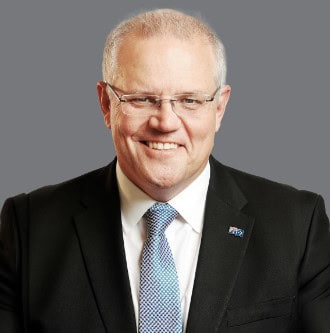
Scott Morrison, AGS Non-Executive Vice Chairman
View from Downunder provides geopolitical insights to AGS clients from an Indo-Pacifc perspective, to assist them navigate the contemporary global geopolitical, security and economic environment. In this edition, I focus on the new Trump Administration, with a focus on the impacts of early economic and global security initiatives both within the US and globally.
Executive Summary
Over the past quarter, the global economic and geopolitical landscape has experienced a series of seismic shifts. This edition of View from Downunder (VFD) unpacks how these forces are reshaping the global outlook, namely US economic policy reforms, major global conflicts and the recasting of global alliances.
The second Trump administration has pursued an unorthodox but targeted economic strategy under Treasury Secretary Scott Bessent. The plan’s linchpin is to restore growth above 3%, fuelled by broad-based tax cuts via the Big Beautiful Bill (BBB), structural reforms to energy supply, permitting processes, and SME finance, and 10% baseline revenue raising tariffs on imports. While initially disruptive, tariff settings are being digested, with expectations of a 10-15% average rate (not including specific tariffs on automotive, steel and aluminium) as reciprocal deals (notably with India, Japan, and Vietnam) advance.
The Federal Reserve remains in a bind, caught between stagflationary pressures of softening growth (Q1 GDPcontracted 0.5%), lingering inflation (~3%) and a cooling labour market. Rate cuts are likely delayed, given uncertainty around the full impact of tariff measures. Still, the Fed’s reluctance is being met by fiscal assertiveness. Bessent’s fiscal play hinges on raising productivity and confidence-led investment to grow out of debt. Despite market concerns over yields and fiscal sustainability, the S&P and 10 year Treasury yields have recovered from the April shock, and consumer sentiment shows resilience.
Internationally, in the Middle East, coordinated US-Israeli strikes have significantly weakened Iran’s capacity to project regional power. These actions, combined with the collapse of Iran’s proxy infrastructure—including Hamas, Hezbollah, and the Assad regime—have delivered a strategic reset. President Trump’s intervention was reluctant but calibrated, designed to inflict maximum damage without broader military entanglement.
Iran’s isolation was evident, and while risks remain in the Red Sea and Strait of Hormuz, markets have proven more resilient to energy shocks than in previous decades.
In Europe, the Ukraine conflict remains stalemated. Ukrainian resilience and expanded drone capabilities have shifted the tempo, but Russia’s response has been punishing. Trump’s tone toward Putin has hardened following rebuffed diplomatic overtures. With NATO partners now committing to raise defence spending to 5% of GDP, the US is enabling a more robust European defence posture, freeing up strategic capacity to focus on the Indo-Pacific.
In Taiwan, the Lai Government is enhancing asymmetric defences amid a persistent invasion threat from China. Despite parliamentary resistance, President Lai has increased defence investment, expanded conscription, and deepened ties with US and Five Eyes intelligence networks. A recall vote on opposition MPs on July 26 will test public support for this security-focused agenda.
Elsewhere in the Indo-Pacific, ambiguity is emerging. South Korea’s new president, Lee, is a populist pragmatist whose defence stance is still not clear. In Japan renewed political instability is likely after a poor showing by the LDP in Tokyo’s recent municipal elections and the potential for Prime Minister Ishiba to be at risk of losing LDP control of the Upper House at national elections later this month. Meanwhile, India remains a standout—active in tariff negotiations and increasingly central to Quad dynamics, while others like Malaysia and Indonesia are hedging, increasing engagement with China and BRICS, further complicating alignment efforts in the Indo-Pacific. For many in the region, economic development still trumps geopolitical positioning, and US tariffs are sending mixed signals. Greater corporate engagement and capital flows will be critical to restoring trust and influence, especially in SE Asia.
In Australia, relatively calm waters prevail with a strong macro position—low gross debt (34% of GDP), modest deficit (~1.0%), low inflation (2.1%), and AAA-rated creditworthiness. Yet structural reform is urgently needed to address productivity constraints. With a surprise election win delivering a clear majority, the Albanese Government has no excuse for inaction. Treasurer Jim Chalmers’ proposed productivity summit in August is under pressure to deliver substance.
Geopolitically, Australia is at risk of drifting. Defence spending (around 2% of GDP), is below US expectations, and the AUKUS partnership faces strain, with Virginia-class submarine sales under a Pentagon initiated review. Meanwhile, US tariffs remain at baseline levels (except for aluminium and steel), with limited relative commercial fallout. However, diplomatic repair is essential to preserve Australia’s status as a Tier 1 US ally.
Looking ahead, markets are recalibrating. Despite the policy theatrics and fiscal risks, the resilience of US consumers and emerging clarity on tariff setting ssupport a more optimistic outlook. Investors are increasingly looking through political noise and refocusing on fundamentals.
In a world where disruption and uncertainty will continue to be the working assumption, there is a premiumon investments and business choices that will not immediately come to mind (not in a good way) when you next scroll your news feed and find out what just happened next.
Download the full brief below:
View From Downunder – July 2025
To stay up to date on what AGS is doing, follow us on LinkedIn